Preparing Your Business for Sale: A Practical Guide
The difference between a good exit and a great one is usually preparation. Businesses that are “sale-ready” command higher multiples, attract better buyers, and close faster. Here’s what that actually means in practice.
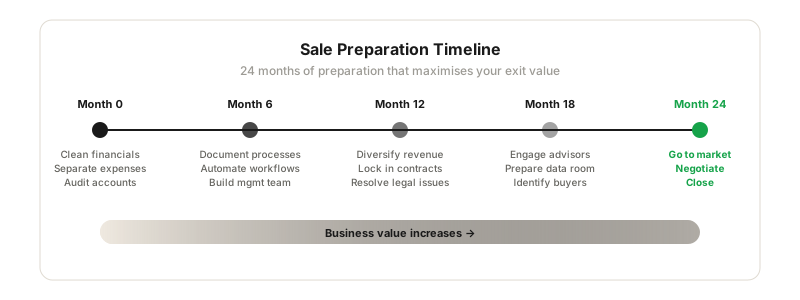
Start Two Years Out
The most common mistake owners make is deciding to sell and then trying to prepare. By that point, you’re optimising under time pressure, and sophisticated buyers can tell. The best exits start with 18–24 months of deliberate preparation.
That doesn’t mean you need to commit to selling. It means running the business as if it were for sale — which, incidentally, also means running it better.
What Buyers Actually Look For
After 17 years of M&A advisory, we’ve seen hundreds of acquisitions from both sides. The businesses that command premiums consistently share these characteristics:
Clean financials
This sounds obvious but it’s where most deals slow down or die. Buyers want to see audited or reviewed financial statements, clear revenue recognition, normalised EBITDA with defensible add-backs, and a clean separation between business and personal expenses. Get your accountant involved early.
Documented processes
If your operations live in people’s heads, that’s a risk factor. Buyers want to see documented workflows, standard operating procedures, and systems that work without specific individuals. This is also where AI and automation pay dividends — automated processes are inherently documented.
A management layer
(For a deep dive on this topic, see Key-Person Risk Is Killing Your Valuation.)
Can the business run for 30 days without you? Harvard Business Review highlights that buyers consistently cite management team quality as the single strongest predictor of post-acquisition performance. If not, you don’t have a business — you have a job. Building a management team that can operate independently is one of the highest-value things you can do pre-sale. It directly reduces key-person risk and increases buyer confidence.
Diversified revenue
Customer concentration is a valuation killer. According to Corporate Finance Institute, buyers typically apply a 10–30% discount for businesses where a single client exceeds 20% of revenue. If any single client represents more than 15–20% of revenue, start diversifying now. This might mean investing in sales and marketing, expanding service lines, or entering new markets.
Growth trajectory
Buyers don’t just pay for what you’ve done — they pay for what they believe you’ll do next. A business with flat revenue and strong margins is worth less than one with moderate growth and a clear path to more. Show the trajectory, not just the snapshot.
The Preparation Checklist
If you’re thinking about a sale in the next 2–3 years, here’s where to focus:
— Get your financial statements audited or reviewed
— Separate personal expenses from business expenses
— Document key processes and automate where possible
— Build or strengthen your management team
— Reduce customer concentration below 15% per client
— Resolve any outstanding legal, tax, or compliance issues
— Lock in key contracts and client agreements
— Invest in systems and technology that reduce manual work
For a clear view of how valuation actually works, read What Is Your Business Actually Worth?.
The Paradox of Preparation
Here’s the irony: the things you do to prepare your business for sale are the same things that make it a better business to own. Many owners who go through this process decide not to sell — because the business is now running so well that they want to keep it.
That’s a good outcome too. A well-prepared business gives you options. You can sell, raise capital, bring in a partner, or keep running it. The worst position is having no options at all.
If you’d like to talk through where your business stands and what preparation might look like, we’re happy to have that conversation. No pitch, no pressure — just an honest assessment from people who’ve done this hundreds of times.
Thinking about a sale in the next 2–3 years? Amafi Capital helps business owners prepare — from operational improvements and AI automation to financial clean-up and management team building. Get an honest assessment.

About the Author
Daniel Bae
Managing Partner, Amafi Capital
Daniel is an investment banker with 17+ years of experience in M&A, having advised on deals worth over US$30 billion. His career spans Citi, Moelis, Nomura, and ANZ across London, Hong Kong, and Sydney. He founded Amafi Capital to combine growth capital with hands-on AI expertise — giving SME business owners across Asia Pacific the partner they need to modernize and scale.