EBITDA Explained for Business Owners
If you’re thinking about selling your business, raising capital, or bringing in a partner, you’ll hear one acronym more than any other: EBITDA. It stands for Earnings Before Interest, Taxes, Depreciation, and Amortisation — and it’s the single most important number in how buyers and investors value your business.
What EBITDA Actually Measures
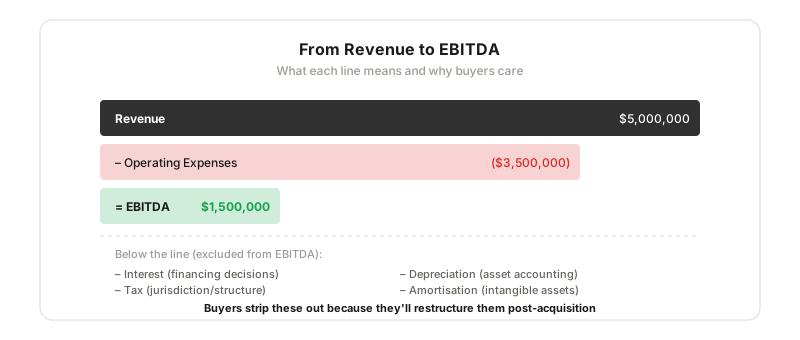
At its core, EBITDA measures your business’s operating profitability — how much cash the core operations generate before accounting for how the business is financed, what tax structure it sits in, and how its assets are depreciated.
According to Investopedia, EBITDA became the standard valuation metric because it allows buyers to compare businesses on a level playing field, regardless of their capital structure, tax jurisdiction, or asset base.
The formula is simple:
EBITDA = Net Profit + Interest + Taxes + Depreciation + Amortisation
Or, starting from revenue:
EBITDA = Revenue – Operating Expenses (excluding interest, tax, D&A)
Why Buyers Care About EBITDA, Not Profit
Your net profit is affected by how you’ve structured your business — the debt you carry, the tax strategies you use, and how you depreciate assets. A buyer is going to restructure all of that anyway. They want to know what the business earns from its operations, stripped of the current owner’s financial decisions.
EBITDA gives them that. It’s the cash generation of the business before the buyer applies their own capital structure.
What “Normalised” EBITDA Means
Raw EBITDA straight from your accounts is rarely the number that matters. Buyers and investors work with “normalised” or “adjusted” EBITDA — which adds back expenses that wouldn’t exist under new ownership:
— Owner’s excess compensation. If you’re paying yourself $400K but a replacement CEO would cost $250K, the $150K difference gets added back.
— One-off costs. A legal dispute settlement, a one-time relocation cost, or a pandemic-related expense — these aren’t recurring and get added back.
— Personal expenses run through the business. The car, the club membership, family travel — if it’s a personal benefit, it gets normalised out.
— Related-party transactions. Rent paid to a property you own at above-market rates, or services purchased from a family member’s company, get adjusted to market rates.
Corporate Finance Institute notes that normalised EBITDA adjustments can increase the stated figure by 20–40% for owner-operated SMEs — a significant difference when a multiple is applied.
The Multiple: Where EBITDA Becomes Valuation
Your business value is typically expressed as a multiple of EBITDA:
Business Value = EBITDA × Multiple
A business with $2M normalised EBITDA trading at 5x is valued at $10M. The same business at 7x is worth $14M. The multiple is where the real leverage is.
What drives the multiple higher? Recurring revenue, scalable operations, low key-person risk, customer diversity, and growth trajectory. For a detailed breakdown, see What Is Your Business Actually Worth?.
Common EBITDA Mistakes
— Overstating add-backs. Buyers will scrutinise every adjustment. If you add back $200K in “one-off” costs that happen every year, that’s not one-off — and you’ll lose credibility.
— Ignoring the trend. A $3M EBITDA that’s been declining for two years tells a very different story than one that’s been growing. Buyers pay for trajectory, not just the snapshot.
— Confusing revenue with EBITDA. A $10M revenue business with 10% EBITDA margins ($1M) is worth far less than a $5M revenue business with 40% margins ($2M). Margins matter more than topline.
— Not getting professional help. Have your accountant prepare a quality of earnings report before going to market. It’s the single best investment you can make in the sale process.
What You Can Do Now
If you’re 2–3 years from a potential sale or capital raise, start tracking your normalised EBITDA quarterly. Identify the adjustments, document them clearly, and work on improving the underlying number through operational efficiency.
This is exactly where AI and automation create measurable value — by reducing costs, eliminating manual labour, and improving margins in ways that flow directly to EBITDA.
Want to understand what your EBITDA means for your valuation? Amafi Capital helps business owners translate their financials into a clear picture of what their business is worth — and what they can do to improve it. Let’s talk numbers.

About the Author
Daniel Bae
Managing Partner, Amafi Capital
Daniel is an investment banker with 17+ years of experience in M&A, having advised on deals worth over US$30 billion. His career spans Citi, Moelis, Nomura, and ANZ across London, Hong Kong, and Sydney. He founded Amafi Capital to combine growth capital with hands-on AI expertise — giving SME business owners across Asia Pacific the partner they need to modernize and scale.