How AI Increases the Value of Your Business
There’s a direct line between operational efficiency and business valuation. AI and automation aren’t just cost-cutting tools — they’re value-creation engines that change how buyers and investors assess what your business is worth.
The Valuation Connection
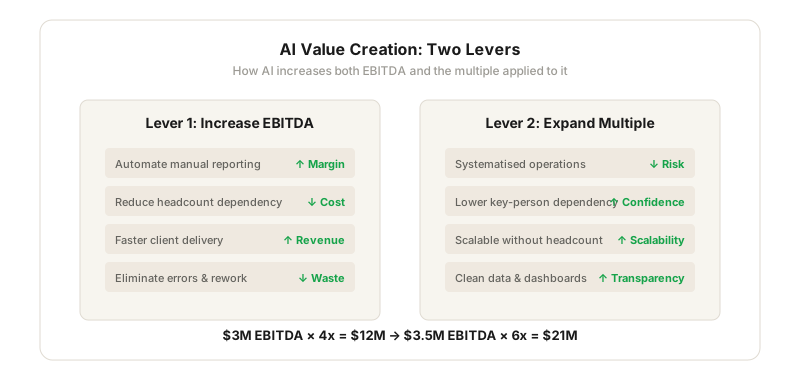
Business value is fundamentally about two things: how much cash the business generates, and how confident a buyer is that it will keep generating it. AI directly improves both.
On the cash generation side, automation reduces labour costs, accelerates service delivery, and eliminates errors that cost money. A professional services firm that automates its reporting might save 20 hours per week of analyst time. That’s real margin improvement that flows straight to EBITDA.
On the confidence side, systematised operations reduce risk. When processes are documented, automated, and data-driven, the business is less dependent on any single person — including the owner. Buyers pay a premium for that kind of resilience.
Where AI Creates the Most Value
Not every AI project is worth doing. The highest-value applications in SMEs tend to be unglamorous but high-impact:
— Automated reporting and dashboards. Replacing manual spreadsheet reporting with real-time dashboards that pull directly from your systems. The time savings are immediate, but the bigger value is in the decision-making quality — you see problems faster and act on better data.
— Client onboarding and intake. AI that reads documents, extracts data, and populates your systems. What used to take a team member two hours now takes two minutes. The client experience improves. The error rate drops. The team focuses on work that actually requires human judgment.
— Sales and churn prediction. Models that score leads, forecast revenue, and flag at-risk clients before they leave. These don’t replace your sales team — they make your sales team dramatically more effective.
— Workflow automation. Connecting your tools so data flows automatically between them. No more re-keying information from email into your CRM, from your CRM into your billing system, from your billing system into your reporting. Every manual handoff is a cost and an error risk.
The Multiple Effect
McKinsey’s 2024 State of AI report found that companies adopting AI report average cost decreases of 10–19% in the business units where it’s deployed. For SMEs, where margins are tighter and operations are more manual, the relative impact is even larger.
Here’s where it gets interesting. AI doesn’t just increase EBITDA — it can increase the multiple that buyers apply to that EBITDA. A business with $3M EBITDA and manual operations might trade at 4x ($12M). The same business with automated operations, clean data, and scalable systems might trade at 6x ($18M). That’s a 50% increase in value from the same underlying revenue.
Why? Because the automated business is easier to scale, less risky to own, and more attractive to integrate into a larger platform. Buyers see a business that can grow without proportionally growing costs — and they’ll pay for that.
If your business is still heavily reliant on spreadsheets, that’s often the single best place to start. See The Real Cost of Running on Spreadsheets for a breakdown of the hidden costs.
You Don’t Need to Be a Tech Company
According to Harvard Business Review, the businesses seeing the fastest ROI from AI are those with large volumes of repetitive, rules-based tasks — exactly the profile of most SMEs.
The businesses that benefit most from AI are decidedly not tech companies. They’re accounting firms, recruitment agencies, healthcare practices, logistics operators, and professional services businesses. Companies with strong fundamentals, loyal clients, and operations that still run on email, spreadsheets, and people doing repetitive tasks.
The transformation doesn’t require rebuilding your business from scratch. It starts with identifying the 3–5 processes that consume the most time relative to their value, and automating them. The ROI is usually visible within 90 days.
For a deeper look at where most SMEs stand on AI readiness, read The AI Readiness Gap in SMEs.
The Competitive Window
Right now, AI adoption in SMEs is early. Most of your competitors haven’t done this yet. That means there’s a window — probably 2–3 years — where the businesses that move first will create structural advantages that are very difficult to close.
Lower cost base. Faster operations. Better client experience. More scalable model. These advantages compound over time, and they show up directly in what your business is worth.
At Amafi Capital, this is exactly what we do. We invest in businesses and then deploy our AI team to build these systems. If you’re curious about what AI could do for your business — and your valuation — we’re happy to talk through it.
Curious what AI could do for your valuation? Amafi Capital embeds AI engineers directly into the businesses we invest in. Tell us about your business and we’ll walk through what the first 90 days could look like.

About the Author
Daniel Bae
Managing Partner, Amafi Capital
Daniel is an investment banker with 17+ years of experience in M&A, having advised on deals worth over US$30 billion. His career spans Citi, Moelis, Nomura, and ANZ across London, Hong Kong, and Sydney. He founded Amafi Capital to combine growth capital with hands-on AI expertise — giving SME business owners across Asia Pacific the partner they need to modernize and scale.