The Real Cost of Running on Spreadsheets
Every business starts on spreadsheets. The problem is that many never leave them. What works at $500K in revenue becomes a silent tax on your business at $5M — one you’re paying every day without realising it.
The Hidden Labour Cost
Spreadsheets don’t look expensive because there’s no line item on your P&L that says “spreadsheet maintenance.” But add up the hours: someone updating the weekly report, someone reconciling data between two sheets, someone re-entering information from email into your tracker, someone fixing a broken formula.
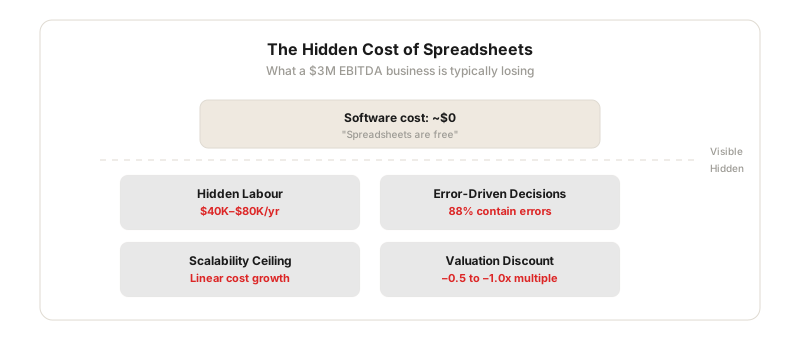
In a typical SME, we find 15–30 hours per week of labour spent on spreadsheet-related tasks that could be fully automated. At an average loaded cost of $50/hour, that’s $40,000–$80,000 per year in hidden labour. For a $3M EBITDA business, that’s a 1–3% margin improvement sitting on the table.
The Error Rate Problem
Research consistently shows that 88% of spreadsheets contain errors, according to studies cited across financial industry publications. Not minor formatting issues — actual calculation errors, broken references, and incorrect data. In most businesses, nobody knows because nobody audits the spreadsheet. The numbers look plausible, so they get used.
We’ve seen businesses making pricing decisions, capacity plans, and hiring choices based on spreadsheets with fundamental errors. The cost of those bad decisions dwarfs the cost of the labour — it’s just harder to measure.
The Scalability Ceiling
Spreadsheets work when your business is small enough that one person can hold the whole picture in their head. As you grow, they break in predictable ways:
— Version control chaos. Multiple people editing different copies. Which one is current? Nobody’s sure.
— Single points of failure. The person who built the spreadsheet leaves, and nobody else understands the formulas.
— No real-time visibility. By the time the spreadsheet is updated, the data is already old. You’re driving by looking in the rear-view mirror.
— Linear scaling. More clients means more rows, more tabs, more time. The workload grows linearly with the business — which is exactly the opposite of what scalable operations look like.
If your business is still in the early stages of thinking about AI, The AI Readiness Gap in SMEs covers the three barriers preventing most businesses from acting — and how to overcome them.
What the Alternative Looks Like
As Harvard Business Review has argued, spreadsheets were designed for analysis, not for running operational workflows — yet most SMEs use them for both.
The solution isn’t a massive ERP implementation that takes 18 months and costs a fortune. It’s targeted automation of the specific spreadsheet workflows that consume the most time.
A recruitment firm we worked with had three staff spending a combined 25 hours per week on candidate tracking, client reporting, and invoice reconciliation — all in spreadsheets. We replaced those workflows with automated systems that pulled data directly from their ATS and accounting software. Those 25 hours dropped to near zero. The staff were reassigned to business development. Revenue grew.
The ROI on replacing a spreadsheet workflow with automation is almost always measured in weeks, not years. The labour savings alone typically pay for the build within 2–3 months.
For a detailed look at how these operational improvements translate into higher multiples, see How AI Increases Business Value.
The Valuation Impact
When a buyer looks at a business running on spreadsheets, they see risk and cost. When they see automated systems, real-time dashboards, and data-driven processes, they see a business that scales. The difference shows up directly in the multiple they’re willing to pay.
If your business is still running critical processes on spreadsheets, that’s not a character flaw — it’s an opportunity. At Amafi Capital, we help portfolio companies identify and replace their highest-cost spreadsheet workflows with automated systems. If you’re curious about what that could look like for your business, we’re happy to walk through it.
Still running on spreadsheets? Amafi Capital deploys AI engineers into portfolio companies to replace manual workflows with automated systems — typically within 90 days. Tell us what’s consuming your team’s time.

About the Author
Daniel Bae
Managing Partner, Amafi Capital
Daniel is an investment banker with 17+ years of experience in M&A, having advised on deals worth over US$30 billion. His career spans Citi, Moelis, Nomura, and ANZ across London, Hong Kong, and Sydney. He founded Amafi Capital to combine growth capital with hands-on AI expertise — giving SME business owners across Asia Pacific the partner they need to modernize and scale.