How to Choose the Right Investor for Your Business
Taking an investor isn’t just a financial transaction — it’s choosing a business partner you’ll work with for the next 3–7 years. The wrong investor can be worse than no investor at all. Here’s how to evaluate who you’re getting into bed with.
Not All Capital Is Created Equal
Money is a commodity. A dollar from one investor spends the same as a dollar from another. What isn’t a commodity is everything that comes with the money: the expertise, the network, the operating style, the expectations, and the way the investor behaves when things get difficult.
Harvard Business Review emphasises that the quality of the investor-founder relationship is the single strongest predictor of whether a PE-backed business outperforms.
We’ve seen businesses take money from the wrong investor and spend three years fighting about strategy, governance, and direction — time that should have been spent growing. And we’ve seen businesses take slightly less money from the right partner and create dramatically more value because the relationship worked.
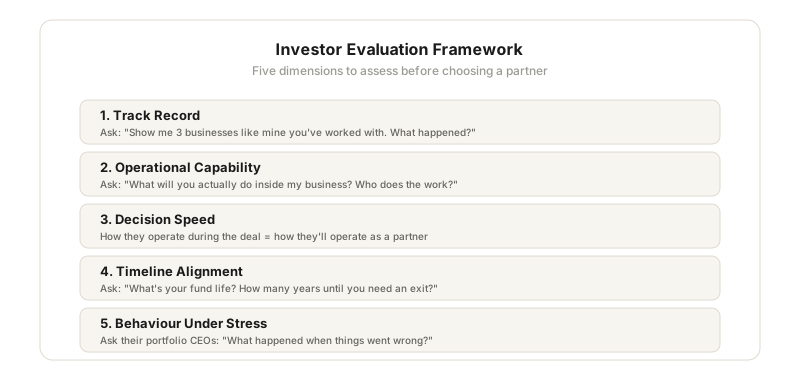
What to Evaluate
Track record with similar businesses
Ask for specific examples of what they’ve done with businesses like yours. Not logo slides — actual stories. What did they do? What changed? What was the outcome? A PE firm that’s invested in 50 tech startups is a very different partner than one that’s worked with profitable services businesses.
Operational capability
Some investors write cheques and show up at quarterly board meetings. Others roll up their sleeves and work inside the business. Neither is inherently better — it depends on what you need. But be honest about what you need, and make sure the investor can deliver it.
If your business needs technology, ask who builds it. If they say “we’ll help you hire someone,” that’s different from “we have an in-house team that will embed in your business.” The difference matters.
Decision-making speed
Some investors take six months to close a deal. Some take six weeks. The speed of their decision-making during the process is a preview of how they’ll operate as a partner. If getting to a term sheet feels like pulling teeth, imagine what board-level decisions will be like.
Alignment on timeline
According to Investopedia’s PE fund lifecycle guide, typical PE fund lives are 10–12 years, but the investment period is usually 3–5 years, with value creation and exit happening over the remaining term.
Every investor has a horizon — the period over which they expect to generate returns. A PE fund with a 10-year life and 4 years remaining will have very different incentives than one with 8 years ahead. Make sure their timeline aligns with yours. If you want to build for five years and they need an exit in two, that tension will define your entire relationship.
Behaviour under stress
This is the hardest thing to evaluate before a deal — and the most important. How does the investor react when revenue drops, a key person leaves, or a strategic initiative fails? Do they panic and micromanage? Do they bring solutions? Do they support the management team or blame them?
The best way to find out is to talk to other business owners they’ve invested in. Ask specifically about difficult periods. That’s when the true character of the partnership reveals itself.
For a broader view of what PE partnerships look like in practice, read What Private Equity Partners Actually Do.
The Questions You Should Ask
— “What specifically will be different about my business because of your involvement?”
— “Can I speak to three portfolio company CEOs — including one where things didn’t go as planned?”
— “What’s the longest you’ve held an investment? What happened?”
— “Who exactly will I be working with day-to-day — and can I meet them before signing?”
— “What happens if we disagree on strategy?”
— “Have you ever removed a founder? In what circumstances?”
If you’re still deciding whether to take investment at all, Selling vs. Raising Capital walks through the full spectrum of options from growth capital to full exit.
Trust Your Instincts
At the end of the day, you’re choosing a partner. The financials matter, the terms matter, the capabilities matter — but so does whether you actually want to work with these people for the next several years. If something feels off during the process, it won’t get better after the deal closes.
At Amafi Capital, we believe the best partnerships start with transparency. We’ll tell you exactly what we do, how we work, and what we expect — and we’ll encourage you to talk to other investors too. The goal isn’t to close a deal; it’s to find the right fit. If that’s us, great. If it’s not, we’ll tell you.
Evaluating potential investors? Amafi Capital is transparent about what we do and how we work — growth capital plus an embedded AI team. Talk to us and decide for yourself.

About the Author
Daniel Bae
Managing Partner, Amafi Capital
Daniel is an investment banker with 17+ years of experience in M&A, having advised on deals worth over US$30 billion. His career spans Citi, Moelis, Nomura, and ANZ across London, Hong Kong, and Sydney. He founded Amafi Capital to combine growth capital with hands-on AI expertise — giving SME business owners across Asia Pacific the partner they need to modernize and scale.