Selling vs. Raising Capital: Which Is Right for You?
Most business owners think their options are binary: sell everything or keep doing what they’re doing. The reality is far more nuanced — and understanding the full spectrum can fundamentally change how you plan your next five years.
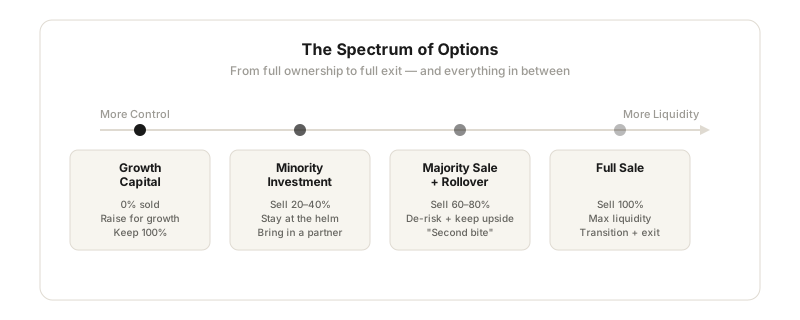
The Spectrum of Options
Between “sell 100% and walk away” and “change nothing” lies a range of structures that most business owners never consider:
— Full sale. You sell 100%, transition over 6–12 months, and move on. Maximum liquidity, minimum ongoing involvement. Right if you’re genuinely ready to step away.
— Majority sale with rollover. You sell 60–80%, take significant cash off the table, but retain a meaningful stake. You stay involved in running the business and participate in future upside. This is the “de-risk and keep building” option.
— Minority investment. You sell 20–40%, bring in a partner with capital and capabilities, and stay firmly at the helm. Less liquidity upfront, but more control and potentially a larger exit down the road.
— Growth capital. Structured as equity or a hybrid instrument. The business raises capital for a specific growth initiative — an acquisition, a geographic expansion, a technology build-out — without you selling any of your existing stake.
Not sure what your business is actually worth today? Start with What Is Your Business Actually Worth? — understanding your valuation is the foundation for every option on this spectrum.
How to Think About It
The right structure depends on what you’re optimising for. Ask yourself three questions:
How much liquidity do you need now? If you’ve had 15 years of personal risk concentrated in one asset, taking some chips off the table is rational. That doesn’t mean you have to sell everything — partial structures exist precisely for this.
Do you want to keep running the business? If the answer is yes, you need a partner, not a buyer. The wrong PE firm will make your life miserable. The right one will give you capital, capabilities, and the freedom to focus on what you’re best at.
What does your business need to reach the next level? Sometimes the constraint isn’t capital — it’s capability. If your business needs technology, operational systems, or M&A expertise to grow, the value of a strategic partner goes well beyond the cheque.
The “Second Bite” Strategy
According to Bain & Company’s Global Private Equity Report, rollover equity structures have become increasingly common in the lower middle market, with founders retaining 20–40% stakes in a majority of recent deals.
Here’s something many owners don’t realise: if you take a minority or majority investment, grow the business meaningfully over 3–5 years, and then sell, your remaining stake can be worth more than a full sale today. This is sometimes called the “second bite of the apple” — and it’s one of the most powerful wealth-creation strategies available to business owners.
The maths is straightforward. If your business is worth $10M today and you sell 100%, you get $10M. If instead you sell 40% at $10M, take $4M off the table, grow the business to $25M with the help of your partner, and then sell your remaining 60% — your total proceeds are $19M. The second bite was almost twice the first.
If you’re leaning toward bringing in a PE partner, read How to Choose the Right Investor to understand what to evaluate before signing anything.
Start the Conversation Early
As McKinsey’s research on CEO transitions suggests, the best exits are planned well in advance, not reactive.
The worst time to explore your options is when you’re forced to — by burnout, a health scare, a market downturn, or a competitor who moved faster. The best outcomes happen when owners start thinking about this 2–3 years before they need to act.
We’re always happy to talk through the options with business owners, even if it’s early. Understanding what’s possible is the first step to making a good decision.
Not sure whether to sell, raise, or partner? Amafi Capital helps business owners explore every option — from minority investment to full exit. Let’s talk through what makes sense for you.

About the Author
Daniel Bae
Managing Partner, Amafi Capital
Daniel is an investment banker with 17+ years of experience in M&A, having advised on deals worth over US$30 billion. His career spans Citi, Moelis, Nomura, and ANZ across London, Hong Kong, and Sydney. He founded Amafi Capital to combine growth capital with hands-on AI expertise — giving SME business owners across Asia Pacific the partner they need to modernize and scale.