How Long Does It Take to Sell a Business?
The honest answer: longer than most owners expect. From the moment you decide to sell to the day the deal closes, most SME transactions take 6–12 months. Some take longer. Very few take less.
Understanding why — and what you can control — is the difference between a smooth process and one that drags on, costs you money, and burns you out.
The Typical Timeline
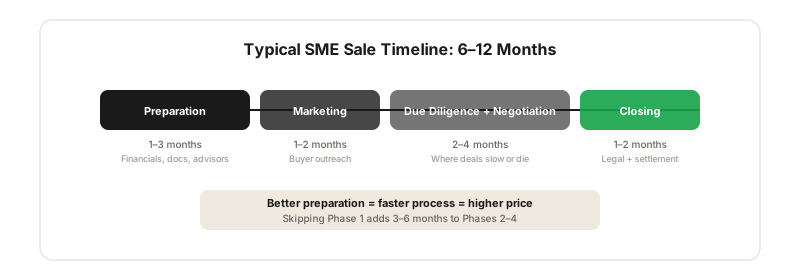
A standard SME sale moves through four phases:
Phase 1: Preparation (1–3 months). Getting your financials audit-ready, documenting processes, preparing an information memorandum, and engaging advisors. This is the phase most owners skip — and it’s the phase that determines everything that follows.
Phase 2: Marketing (1–2 months). Your advisor approaches potential buyers, manages confidentiality, and generates initial interest. The quality of your preparation directly affects how many serious buyers engage.
Phase 3: Due diligence and negotiation (2–4 months). The buyer digs into your financials, operations, legal, and contracts. This is where deals slow down or die. According to Harvard Business Review, due diligence delays are the number one cause of deal failure in the middle market.
Phase 4: Closing (1–2 months). Legal documentation, final approvals, financing arrangements, and settlement. Typically the most predictable phase.
What Slows Things Down
The most common delays we see:
— Messy financials. If your accounts aren’t clean, due diligence takes twice as long. Buyers need to trust the numbers, and if they can’t reconcile your P&L quickly, they start digging deeper — or walking away.
— Key-person dependency. Buyers who discover the business can’t function without the owner get nervous. They’ll either slow down to figure out a transition plan or renegotiate the price. (See Key-Person Risk Is Killing Your Valuation for how to address this.)
— Customer concentration. A buyer who sees that 30% of revenue comes from one client will spend weeks assessing that risk. They may require earnout provisions or contract extensions, both of which add complexity and time.
— Legal issues. Outstanding disputes, unclear IP ownership, non-compliant contracts, or regulatory gaps all extend due diligence. According to Investopedia, legal due diligence alone can add 4–8 weeks to a transaction.
— Owner indecision. Sellers who aren’t truly committed slow everything down. Delayed responses, scope changes, and emotional second-guessing signal to buyers that the deal might not close — and serious buyers move on to opportunities with motivated sellers.
How to Speed It Up
The businesses that sell fastest share common traits:
— Clean, audited financials ready before going to market
— Documented processes — ideally automated, so the buyer can see the business runs without specific individuals. This is where AI and automation pay for themselves many times over.
— A management team that can run the business through the transition
— Pre-populated data room with contracts, leases, employee agreements, and client lists organized
— A clear reason for selling that doesn’t make the buyer nervous
For a complete preparation checklist, see Preparing Your Business for Sale.
The Cost of Waiting
Every month a sale process drags on has a cost. Your attention is divided between running the business and managing the deal. Key employees may hear rumours and start looking elsewhere. Market conditions can shift. The buyer’s enthusiasm fades.
We’ve seen deals that should have taken 8 months stretch to 18 — not because the business was bad, but because the preparation wasn’t done. The owner ended up accepting a lower price out of exhaustion.
The best antidote is preparation. Start the work 18–24 months before you want to be done, and the process itself becomes dramatically smoother.
Thinking about a sale? Amafi Capital helps business owners prepare and execute — from operational improvements to deal structuring. Start with a conversation about your timeline and goals.

About the Author
Daniel Bae
Managing Partner, Amafi Capital
Daniel is an investment banker with 17+ years of experience in M&A, having advised on deals worth over US$30 billion. His career spans Citi, Moelis, Nomura, and ANZ across London, Hong Kong, and Sydney. He founded Amafi Capital to combine growth capital with hands-on AI expertise — giving SME business owners across Asia Pacific the partner they need to modernize and scale.